Friday, June 24, 2011

Wonderland Chess

As some of you may know, I have gone through some changes lately. A couple nights ago, while unpacking some boxes, I came across two little boxes of what look like small playing cards. They are actually chess pieces.

Each piece is made of four cards. They are four of the same card and they are taped together and cut in such a way that they can stand straight up and be seen from all angles as the same card. From the top each piece looks like an X.

There should be four boxes of pieces like this; one for each suit. I can only find two.

I know, this is supposed to be about chess and those look like cards. So let me explain.

Back in high school I had these dreams about Wonderland. Actually, the dreams continued for several years past high school. The most memorable Wonderland inspired dream starred the White Rabbit and Mad Hatter driving a Ford Model T through the streets of Lake Havasu City. Of course they were going way too fast and overturned the car. I tried to talk to the Rabbit, but he kept tapping his watch. The two used the hand crank so vigorously that they righted the car and sped off.

There was often a chess theme in these Wonderland dreams. Floors were black and white or black and red and the cards would move about in what I thought to be random directions. Or that is what I believed after the first two or three of these dreams. Upon further reflection and more dreams I realized the cards were moving about Wonderland using the movements of the Kings, Queens, Knights, and pawns of chess.

One day I was about to leave a store when I saw party favors on sale. I reached into the bin with the tiny bicycle decks, and pulled one deck out. There was a furious spinning in my mind and then I could see my red and black folding chess board with the cards moving on it in place of my usual chess pieces.

I did the quick math and threw the four tiny decks in my cart (how many kids would appreciate playing cards anyway?). About an hour later I had my chess board all set up with my new pieces. I made a special game of chess with four players. I modeled Wonderland Chess after Enochian Chess.

I had read about the symbolism of playing cards. The four suits are the four seasons (four Elements) and the 52 cards are the 52 weeks in the year, and this amazing surreal game made much more sense to me than that convoluted Golden Dawn creation.

What I didn't realize until years later... I had recreated Four Seasons Chess. Four Seasons Chess is, ironically, the game Enochian Chess was based upon.

Now I want to make a new set of pieces using a four-color deck.

Tuesday, June 21, 2011

The Goetic Ring of Solomon

After my recent post about the Triangle of Solomon, I remembered that there was another item in the Goetia that used the words Tetragrammaton and Anaphaxeton. That item is the Ring of Solomon.

The ring appears in the Mathers/Crowley edition of the Goetia. It is presented as a kind of disc with concentric rings.

Many people have used this design as a bezel on a ring or a disc that hangs as an amulet of sorts.

The illustrations of the ring which appear in the original manuscripts look like this:
I once saw a diagram like this used in a book describing finger rings. The diagram was laid out the same, but with different words. The description revealed that the diagram was of a plain band with writing on the outside and also the inside of the band. If we assume the Ring of Solomon shown here is a similar design, we see Tetragrammaton is engraved on the inside of the band and the words "Anapheneton (or Anaphaxeton) + Michael" are written on the outside of the band.

The Ring is to be made of Silver and worn on the middle finger of the left hand. It is to be held to the nose of the Master when confronted with the "stinking fumes of spirits".

Many people claiming to have great Goetic experience say the Ring is useless because the spirits have no odor. One could argue the spirits don't have bodies either. Yet we see them anyway.

Even if you are of the belief that spirits only affect the sense of sight, there is another, more practical use for the ring.

In The Key of Solomon, Book 2 Chapter 10, we read:
There are many kinds of Incense, Suffumigations, and Perfumes, which are made for and offered unto the Spirits; those which are of sweet odour are for the good, those which are of evil savour are for the evil.

The Key of Solomon and the Goetia of Solomon may be different, but they follow the same reasoning. In the GoS, when the spirit is being conjured, the exorcist goes through a series of appeals and threats. The exorcist starts with the first and second conjuration. If that fails, he reads a stern "constraint". If even that fails, the exorcist demands the spirit's boss (or King, as it were) send the spirit right away. If that fails, the exorcist recites the "Spirits Chaine" and threatens to send the spirit to the depths of hell bound "in chaines of fire and Brimstone unquenchable, unless you dost forthwith appear before this circle in This Triangle to doe my will..."

After the Spirit Chain the spirit had better be there with bells on. If the spirit still isn't there (or your scryer is no good), the GoS instructs the exorcist:
Then write his name and seal in [on] virgins parch [parchment] and put it into a black Box with Brimstone aquafateda [assafoetida] and such things that have a stincking strong smell and bind the Box round with a wire and hang it on ye swords point and hold it over the fire of Charcoles...
There follows "The Conjuration of the Fire". With the spirit's seal in a black box bound with chains along with "such things that have a stincking strong smell", the exorcist holds the spirit over hot coals and threatens it with eternal suffering starting right about now.

If even this threat and torture does not work, the exorcist recites "The Curse" and drops the black box into the hot coals. That's right, 'it just got real up in the chamber. The exorcist is now making good on his promise to send this rebellious spirit to the fiery pit of Hell! If the spirit does not appear, I suppose he gets sent to Hell forever and crossed out of everyone's grimoires.

Luckily, the GoS tells us:
Here the Exorcist must put the box into the fire and by and by he will come. But as soone as he is come quickly quench the fire that the Box is in and make a sweet perfume and give him a kind entertainment shewing him the pentacle that is at ye bottom of ye vesture covered with linnen cloath, saying. 

So, what does this have to do with the Ring of Solomon?

In Antiquities of the Jews, Josephus writes:
God also enabled him (Solomon) to learn that skill which expels demons, which is a science useful and sanative to men. He composed such incantations also by which distempers are alleviated. And he left behind him the manner of using exorcisms, by which they drive away demons, so that they never return; and this method of cure is of great force unto this day; for I have seen a certain man of my own country, whose name was Eleazar, releasing people that were demoniacal in the presence of Vespasian, and his sons, and his captains, and the whole multitude of his soldiers. The manner of the cure was this: He put a ring that had a Root of one of those sorts mentioned by Solomon to the nostrils of the demoniac, after which he drew out the demon through his nostrils; and when the man fell down immediately, he abjured him to return into him no more, making still mention of Solomon, and reciting the incantations which he composed. And when Eleazar would persuade and demonstrate to the spectators that he had such a power, he set a little way off a cup or basin full of water, and commanded the demon, as he went out of the man, to overturn it, and thereby to let the spectators know that he had left the man; and when this was done, the skill and wisdom of Solomon was shown very manifestly: for which reason it is, that all men may know the vastness of Solomon's abilities, and how he was beloved of God, and that the extraordinary virtues of every kind with which this king was endowed may not be unknown to any people under the sun for this reason, I say, it is that we have proceeded to speak so largely of these matters.  

As you can see, the exorcist's ring is treated with an herb (Root).  The herb and the ring work together with incantations handed down from Solomon in order to command the demon. In the Goetia of Solomon, the Exorcist is to hold the Ring to his own nose. The powerful herbs on the Ring counters not only the odor of demons, but also the odor of the foul smelling substances used while conjuring demons. The exact words in my GoS are "This Ring is to be held before the face of the Exorcist to preserve him from The stinking fumes of spirits &c." I think this includes sulfur, brimstone, and assafoetida.

I have heard of crime scene investigators rubbing different salves and creams with menthol and similar substances on their nose and upper lip when investigating foul crime scenes. The menthol makes the odor more bearable. The herbs used on the Exorcist's ring may have a similar effect.

Now, I'm not saying to use Vicks VapoRub in place of the Ring of Solomon. I'm just pointing out the fact that the Ring of Solomon may need to be treated with a powerful herbal concoction to render it useful against foul suffumigations.

In closing this post I give you my version of the Goetic Ring of Solomon:

Saturday, June 18, 2011

Reconstructing Solomon's Triangle

I have been discovering occult blogs the last few days. You have the usual spells/home remedy type stuff. These have become more of a curiosity with all the over the counter remedies you can get these days. You have your harmonic alien chakra crystals. You have Thelemic treacle. There's the same introductory Runic lore you can find in old '80s paperbacks. And then...

Yesterday I read a blog post about the Triangle of Solomon. I highly recommend reading the post HERE.

The goal is to understand the Triangle of Solomon as it appears in the Goetia. The theory is that the original Triangle was in Hebrew.

While reading the blog I was reminded of a time back in the late '90s (on further reflection I believe it was '94 or 95) when I and a friend of mine decided we would attempt to reconstruct the original Magical Triangle of Solomon. Our reasoning was much like that in the article linked to, but with one difference.

For those of you who have clicked the link to read the article and comments, let me risk some redundancy.

We start the reconstruction of Solomon's Triangle with the word Tetragrammaton. Tetragrammaton is the unspeakable four letter name of God. Many books and websites detail this fact. Far too many sources to list here.

Since all three words around the triangle of Art have a similar ending, they probably represent three names of God.

Primeumaton is probably God's Prime (first or primary) name. The first and most commonly used name of God (in the Hebrew Old Testament) is Elohim.

This is the line of reasoning I followed and which seems to be the line of reasoning for the others who have tried to decipher the Triangle.

The last word of the Triangle is Anaphaxeton. Gilbert, in his excellent article breaks down the word Anaphaxeton into its separate parts and suggests AHYH as the possible original Hebrew name of God.

As I was in public high school at the time, and knew only the smattering of Greek, Latin, and Hebrew I could pick up from grimoires, I came to a very different conclusion about Anaphaxeton.

My only copy of the Goetia had a little section called "An Explanation of Solomon's Triangle". The line describing Anaphaxeton reads:
Anephezeton.  Thou great God of all the Heavenly Host:

This implied to me that Anaphaxeton was related to the Heavenly Host. The one word that comes to mind is Tzabaoth.

The resulting Triangle of Solomon looks like this:

Back then I was using modern Hebrew characters, but thanks to Carroll "Poke" Runyon, I know to use older characters. When the words are substituted and read from the Tetragrammaton we have the words "YHVH Elohim Tzabaot". There is the ineffable Name and the Alpha and Omega (Aliph is the first letter of Elohim, and Tau is the last letter of Tzabaoth).

In The Key of Solomon the King (Clavicula Salomonis),  Book 1, Chapter 5 there is a conjuration in which spirits are commanded by the many Names of God. After the list of names, the spirits are conjured
"by the troops of Angels who cease not to cry day and night, QADOSCH, QADOSCH, QADOSCH, ADONAI ELOHIM TZABAOTH"

In Chapter 9 of Book 1 there is an oration which reads in part:
Thou Who art seated upon the Kerubim and the Seraphim, in the high places, whereunto human understanding cannot penetrate: Thou Who hast created all things by Thine agency, in Whose Presence are the Living Creatures, of which four are marvellously volatile, which have six wings, and who incessantly cry aloud:
"QADOSH, QADOSH, QADOSH, ADONAI ELOHIM TZABAOTH, Heaven and Earth are full of Thy glory";
Both of these passages refer to Isaiah 6:1-4
1In the year that king Uzziah died I saw also the LORD (YHVH) sitting upon a throne, high and lifted up, and his train filled the temple.
 2Above it stood the seraphims: each one had six wings; with twain he covered his face, and with twain he covered his feet, and with twain he did fly.
 3And one cried unto another, and said, Holy, holy, holy, is the LORD (YHVH) of hosts (Tzabaoth): the whole earth is full of his glory.
 4And the posts of the door moved at the voice of him that cried, and the house was filled with smoke.

The Adonai of the Key of Solomon is YHVH. You will notice the passage in Isaiah lacks the word Elohim while the Key of Solomon includes it, twice. I do not think that is a mistake. It is my belief that the magic circle is a symbolic representation of this vision of Isaiah.

The YHVH is in the center, surrounded by the Seraphim (four hexagrams).  The 24 triangles (or wings) are the 24 hours of day and night (24 x 3 = 72).

Or that's the way I imagined it as a teenager. I still think it's a solid reconstruction. Let me know what you think.


UPDATE!
Since writing this post I came across a thread at www.evocationmagic.com
THIS post clearly shows a triangle strikingly similar to my own. I have conversed with the creator of this other Triangle. He also formulated his Triangle of Art in the '90s.

I also just found THIS cool picture of the Triangle at a blog I need to subscribe to. Very crafty stuff there.

I can now think of a couple slight changes that would make the Triangle even better. I don't know if or when I'll get around to drawing them up, but here's a quick explanation:
YHVH should form the base or foundation of the Triangle, opposite the K of MI-K-AL
ALHIM is now on the left with the A in some way highlighted so it stands out
TzBAUTh is on the right hand side of the Triangle with Th highlighted

This is your first and last, the ox and a cross (use the older letters).

All three names should be easily read from within the Circle.

Here's the updated version:
http://theoccultandmagick.blogspot.com/2012/05/triangle-of-solomon-take-three.html

Wednesday, June 1, 2011

Astrolabe Video on Ted.com

While writing my recent article on Elemental Shields I noticed how out of touch people have become with the cycle of the year and even the progression of the seasons. We have come to such a point in social evolution that I even felt I had to explain why I chose green to represent spring and therefore the element of air. As you can see in the article, most people have become detached from the cycle of the year and the elements. They have removed themselves from the night sky and the elements so far that they cannot seem to name the seasons in the proper order or even point out polaris.

In my attempt to educate myself further on this subject I came across a book in Google Books written by Geoffrey Chaucer. The book is called Treatise on the Astrolabe. I started reading the book with the intention of building an astrolabe using cardboard and parchment. I have not gotten around to building the device yet, but I hope to get to it soon.

What struck me while reading Chaucer (I ended up reading more than the book linked to above) was that Chaucer knew the seasons, four winds, stars, constellations, and elemental attributes that confused Agrippa and Levi. Not only that, these things were better known by children in Chaucer's time than by so-called occultist today. While reading Chaucer's Treatise on the Astrolabe, bear in mind it was written for a boy who was ten or eleven years old (sources vary on this point).

I find I've written more than I planned to write. So, here's the video about the astrolabe on Ted.com. Hope you enjoy it.


After seeing the astrolabe in the video I now want to cast an astrolabe in clear or translucent resin.

Friday, May 20, 2011

Grimoire For The Apprentice Wizard: Elemental Shields

One of the books I am currently reading is Grimoire For The Apprentice Wizard by Oberon Zell-Ravenheart. I'm not ready to give a full review of the book, but I thought I should mention a little something about the book's elemental and cardinal correspondences.

On page 120 of the book we are instructed to place four indicators in the cardinal directions. There are four small illustrations given as suggestion. They are four shields with astrological signs and the four alchemical symbols for the elements. When I first saw these I smiled because I was already making similar shields.

After looking over Oberon's shields I was confused. He placed Water in the West and has yellow for the color of Air. Oberon has, of course, used the four colors of the four houses of Hogwarts, so some license must be allowed for the use of color. And since modern people think of green as an Earth color, it makes sense that Oberon would assign it to the element Earth.

Oberon's Shields


East


North


South


West


But now, WHAT IF we were to try and make the four given colors, four elements, and twelve signs conform to the more ancient forms of Western Magic? This is the exercise at hand.

First we must note the attribution of the elements to the four cardinal directions that most people use today. The assignment of the elements to the quarters as used by the Golden Dawn, Oberon, and many Wiccans, can be traced to Eliphaz Levi's Transcendental Magic.

Since Eliphas Levi is not a real ancient source, maybe we should see what our GoTo man, Agrippa, has to say.

Agrippa's Shields


East


North


South


West


As you can see, Agrippa has Fire in the East, Water in the North, Air in the West and Earth to the South. I have to say I didn't see that coming. As for the colors, I have assigned the Hogwarts colors that I thought Agrippa would approve.

Looking at Agrippa's shields I wonder what he was thinking. Was his young brain just overwhelmed by the sheer volume of information he was exposed to? Did he just make a simple error? The world may never know.

How about those Rosicrucians and Alchemists (those guys that came before the Golden Dawn)? Should we make some shields representing their school of thought? Why not!

George Ripley's key as reprinted in Elias Ashmole's "Theatrum Chemicum Britannicum" looks like this:


As you can see, Ripley has assigned the elements and astrological signs to the four cardinal directions. All we have to do is assign the colors of the Houses of Hogwarts. And here they are...

Ripley's Shields


East


North


South


West


Of the three sets of shields produced so far, these shields probably conform most to the ancient arts of magic and alchemy. To make the shields more accurate, they should probably be red, yellow, black, and white. But then we wouldn't be sticking to the Harry Potter theme.

The assigning of green to Air is supported by the majority of sources that are more than 500 years old. If this assignment confuses you, just stop and imagine each shield represents a season. Moving clockwise from the spring Air in the East to the heat of summer in the South and then on through the dryness of autumn and wetness of winter. Also note the symmetry of the elemental symbols.

With this I conclude the exercise.


Resources:
Theatrum Chemicum Britannicum 
 Transcendental Magic
Agrippa's Three Books of Occult Philosophy
Wikipedia Entry about Hogwarts
Oberon's Grey School

Lemegeton:


Thursday, May 5, 2011

Charlemagne's Cipher


While writing my recent article on the Theban Alphabet I was pleasantly surprised by something I recognized from my childhood. Like many young boys I was fascinated by Kings, knights, and crusades. This fascination sometimes crossed with my other interests, like codes and ciphers.

This cipher is the one Charlemagne used to pass messages to his generals. The cipher can easily be found in cryptography and cryptology books at your local library, but it may also be found in Johannes Trithemius' Polygraphia (1518).

Thursday, April 28, 2011

The Theban Alphabet

Entering high school I read and enjoyed Buckland's Complete Book of Witchcraft. I began writing notes in runes and then in the mysterious Theban Alphabet. All I knew about the Theban Alphabet is that it's used by many Witches AND IT LOOKS COOL!
This lasted only a few months and then I moved on to other things.

Recently, though, I have decided I should write my journals in some kind of alternate script. One script I am considering is the mysterious Theban Alphabet. So I thought I'd make a little blog post about the script.

And that's what it is, a script. It appears to be an alternate script for use with the Latin Alphabet.

The oldest known book containing the Theban Alphabet is Johannes Trithemius' Polygraphia (1518)

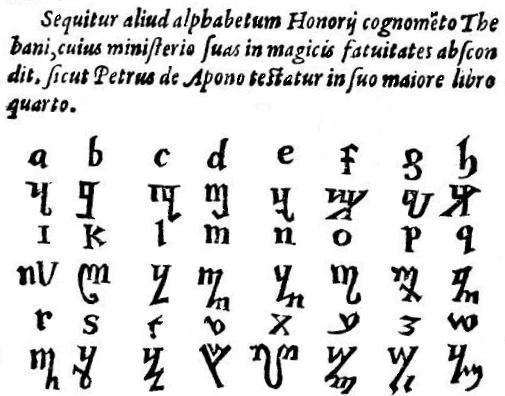
The Latin reads:
“Sequitur aliud alphabetum Honorii cognomento Thebani, cuius ministerio suas in magicis fatuitates abscondit, sicut Petrus de Apono testatur in suo maiore libro quarto" (Here follows another alphabet of Honorius surnamed the Theban, and the use thereof is for hiding the foolishness of his magic, as Petrus de Abano testifies in his greater fourth book.)

The 1561 edition shows the following forms for the letters:

Trithemius' student Agrippa would later include the Theban Alphabet in his Three Books Of Occult Philosophy (book 3 published 1533) (Read it online HERE)

Agrippa has the following to say of the origins of the Alphabet of Thebes:
"Ex horum itaque characterum genere sunt, quos notat Petrus Apponus ab Honorio Theba no traditos, quorum figura est talis ad nostrum alphabetum relata:"
“Of this kind of character therefore are those which Peter Apponus notes, as delivered by Honorius of Thebes, the figures whereof are such, being related to our Alphabet.”

Trithemius and Agrippa claim to have read about this alphabet in an older book of magic attributed to Peter Abano. In this book Peter Abano gives the alphabet and tells how its creator, Honorius the Theban, used the alphabet "for hiding the foolishness of his magic".

I wish I had Trithemius' library. It seems the book he and Agrippa cite has not survived down to the present day. So for now the source of the Theban Alphabet is Trithemius' Polygraphia.

The Theban Alphabet appeared in Francis Barrett's The Magus

It is this form of the Theban Alphabet that was used by the Golden Dawn and from there passed down into Wicca by Gerald Gardner.

The last character of this alphabet contains the Alpha and Omega and is used as a period or full stop.

Source: http://histbest.ub.uni-leipzig.de/receive/UBLHistBestCBU_cbu_00000088