Showing posts with label Agrippa. Show all posts

Friday, October 21, 2011

Explanation of the Pentagram and Hexagram of Solomon

I previously wrote about the "Explanation of Certain Names Used in this Book Lemegeton". I glossed over the portion of the "explanations" about the Hexagram and Pentagram of Solomon. After a forum thread at evocationmagic.com, I decided to look more closely at both the "explanation" and the Pentagram of Solomon.

In the following table you will see "The Explanation of the two triangles in the Parchment". The two "triangles" referred to are the Hexagram and Pentagram of Solomon. In the left column are the words from the Hexagram and Pentagram being "explained" by the words in the right column. Under the words as they appear in the manuscript I have included the words that appear in the Mathers/Crowley version. I have colored alternate rows for easier reading.

The Explanation of the two triangles in the Parchment

Alpha and Omega Thou O great God who art the beginning and the end who was before all Eternity and ever shall be


Mathers/Crowley version reads:
Thou, O great God, Who art the beginning and the end:
Tetragrammaton Thou God of mighty power be ever present with us to guard us and protect us and let thy holy presence be now and always with us

Mathers/Crowley:
Thou God of Almighty power, be ever present with us to guard and protect us, and let Thy Holy Spirit and presence be now and always with us:
Soluzen I command thou spirit of what Region soever thou art to come into this circle

Mathers/Crowley:
I command thee, thou Spirit, of whatsoever region thou art, to come unto this circle:
Halliza and Appear in human shape

Mathers/Crowley:
And appear in human shape:
Bellatar

M/C:
Bellator or Bellaton
and speak to us audably in our mother tongue

Mathers/Crowley:
And speak unto us audibly in our mother-tongue:
Bellonoy

M/C:
Bollonoy or Bellony
and shew and discover to us all treasures that thou knowest of or that is in thy keeping and deliver it to us quietly

Mathers/Crowley:
And show, and discover unto us all treasure that thou knowest of, or that is in they keeping, and deliver it unto us quietly:
Hallÿ Fra

M/C:
Halli. Hra.
and answer us all such questions as we shall demand without any defect now at this time

Mathers/Crowley:
And answer all such questions as we may demand without any defect now at this time.

Alpha and Omega

can be found in the Hexagram of Solomon. This is the Beginning and End of the Greek alphabet.

Wikipedia Entry: http://en.wikipedia.org/wiki/Alpha_and_omega

Tetragrammaton

is found in the Hexagram and Pentagram of Solomon. This is, as most people know, the unspeakable four-letter name of God.

Wikipedia entry: http://en.wikipedia.org/wiki/Tetragrammaton

Soluzen

In Folger Shakespeare manuscript V.b.26, this word appears as Soluze with a line above the last two letters. That line means there are missing letters.


Can be found with its sigil in the center of the Pentagram. This is possibly a corruption of the name of Solomon or Jerusalem. Here you see the seal of Jerusalem


(Image snagged from HERE)
Although the seal directly above is dated to the second century, it was in use for several hundred years, including the second temple period. That's the period we start seeing stories of exorcisms and rings handed down by Solomon.
Jerusalem and Solomon contain the same root word, SLM.

NOTE:
Although the word SHAMIR does not appear in this "explanation" or the pentagram in this grimoire, it should be noted that if you omit the Lamed from the seal of Jerusalem above and read from the letter Sin, you will see why this word became part of this legend.

Jerusalem:     Yud Resh Shin (Lamed) Mem
Shamir:          Shin Mem Yud Resh

Halliza

is in the Pentagram with its sigil.

Bellatar

is spelled Ballaton or Ballator in the Pentagram of Solomon. With the grimoiric obsession with creating words with the  "Aton" suffix, I am leaning in favor of Ballaton. Note the "name" begins with Bal or Bel, meaning "master". 

This "Aton" is likely Beleth, the 13th spirit of the Goetia of Solomon. Of Belleth (or Beleth or Bileth or Bilet or Ballat) the Goetia of Solomon Says:
The 13 spirit is called Beleth, he is a mighty king and terrable, ridding on a pale horse wth Trumpets and all other kinds of Musicall Instruments playing before him, he is very furious at his first apperance That is whilest ye Exorcist allay his Courage, for to doe that, he must hold a hazel stick in his hand, streched forth towards ye South & East quarters making a Triangle without ye Circle, commanding him into it by ye vertue of ye Bonds & chaines of spirits hereafter following, & if he doe not come into ye triangle by your Threats, rehearse ye Bounds & chaines before him, and then he will yeild obediance and come into it and do what he is commanded by ye Eorcist [Exorcist], yet he must receive him courteously, because he is a great king & doe homage to him, as the kings and princes doe that attend him, and you must [also] have allwayes a silver Ring on the middle finger of the left hand, held against your face as they do for Amaimon, This king Beleth causeth all ye love that possible may be, both of Men and women till ye Master Eorcist [Exorcist] hath had his mind fullfilled &c. he is of the order of Powers and governeth 85 Legions of [102v] spirits, his Noble seal is this wch is to be worne before you in the Time of working.
Balath's Noble or greater seal is given in the text and his lesser seal appears in the Pentagram of Solomon.

The Hebrew of Dr. Rudd has the name Beth-Lamed-Aleph-Tau.

Bellonoy

is in the Pentagram with its sigil. This name is spelled Bellonoy in the "explanation" and Bellony in the Pentagram of Solomon. Bellony is more likely. As with Bellatar, Bellany's name begins with Bel. I believe that in Hebrew his name may be spelled Beth-Lamed-Lamed-Vav-Nun-Yud. If you use these letters to trace a sigil over the kamea of Mercury (use the one with the Hebrew letters!), you will get something like this:
Most sigils these days begin with a circle and terminate with a little cross-line. As you can see from the image above, Agrippa (and the creators of the grimoires) had no such strict rules. Compare the sigil I have drawn above to the sigil of Bellony as it appears in the pentagram:
Like the Lesser Seal appearing in the Hexagram of Solomon, Bellony's sigil has been degraded and reversed. Compare these two versions of this sigil (1,2):
UPDATE: Find out more about this "sigil" here: http://brotherenochsgoetia.blogspot.com/2015/03/this-sigil-is-not-sigil.html


Another manuscript shows the sigil of Bellony more clearly:
The sigil seems to not include the final 'Y' or Yud. That leaves us Bal-LVN (Lord or master of the Levites), suggesting a Lord and possibly a connection to the Levites or priests of the Temple of Solomon.

Alternately, LVN could be Lamed-Beth-Nun, which means "white". 


Hallÿ Fra

is written (as Hally) in the Pentagram along with its sigil.

ABDIA

is written in the Pentagram along with its sigil. ABDIA does not appear in the "explanation". Abdia is another way of writing Obadiah. In V.b.26, the name is written Abdiah.


This post is more like notes for myself and I will probably return to it from time to time to see if I can make more progress.


Tuesday, August 23, 2011

An Explanation of the Explanations of the Diagrams of Solomon

Within the Mathers/Crowley version of the Lesser Key of Solomon, titled "The Book of the Goetia of Solomon the King" we find three "Explanations". These are actually more like prayers than explanations.

The first explanation is titled "Explanation of Certain Names Used In This Book Lemegeton". This title was made up by Mathers. This is like a prayer for the magic circle (figure 153).

The second explanation is titled "The Explanation of the Two Triangles in the Parchment". As the footnote points out, these words are in the Hexagram (figure 155) and Pentagram ( figure 156) of Solomon.

The third explanation is titled "An Explanation of Solomon's Triangle". As the title suggests, this explains the Triangle of Solomon.

These "explanations" only appear in Sloane 2731. Sloane 2731, like all the other manuscripts used by Mathers in this "translation", is in English. I know Crowley gives a list of languages, but it's just not true.  

Mathers' footnote to the first "explanation" reads:
This explanation, or rather paraphrased prayer, only exists in one codex as far as my knowledge goes. The Qabalist will remark that the orthography of several of the Qabalistical names is incorrect. I give it, however, as it stands.
To this Crowley ads:
In any case it is worthless; the names mean nothing of the sort.

For Mathers to criticize the orthography of the "explanations" is almost as appropriate as criticizing Mathers for spelling Cabalist with a "Q". Most of the words Mathers corrects were correct at the time of writing (as you will see in a little bit). And Crowley's dismissal shows he needed to look a little bit closer since the "explanations" have a source and are a key to understanding the tools used in the Goetia.

When dealing with grimoires you find many languages mixed together and you also find many strange spellings of Greek, Hebrew, and Latin words. It is obvious that most grimoires were composite works, built up over time by several people of varying knowledge of the languages and lore involved. I believe the Lesser Key of Solomon began its life as a catalog of demons. To the catalog conjurations were added. And sigils too. Elements were added layer on layer from other manuscripts. In time errors crept in and were embellished. It is only natural. Do you have a mastery of English, Latin, Greek, and Hebrew as well as astrology, Cabala, correspondences, ritual procedures... If you think it's tough mastering all that in our time, just imagine you live in the 16th century. So we can forgive the author of the "explanations" for any corruptions and minor errors, right? As I have shown before, not even Agrippa is free of such errors.

Consider the word Tetragrammaton. It is a Greek word representing a Hebrew word written in Latin characters in an English manuscript. This is the nature of magic and old grimoires. Tetragrammaton has remained consistently spelled and defined in most books, but other words have not fared so well. You might find the word ANAPHAXETON spelled ANEPHEZETON, or ANAPHENETON.

So, can the words appearing in the "explanations" be traced to more definite sources? I believe they can. But before we get to the source, let's have a look at the first "explanation". The manuscript has planetary symbols and a formatting I will not try to emulate in this blog post. In place of the planetary symbol I will simply write the name of the planet. Also, I will place my comments in brackets [] and in red since there is no easy way to use footnotes on this blog. Numbers are placed for easier reference to the illustration appearing after the "explanation".

The Explanation of the Circle of Solomon


[1] Eheie [2] Kether
         
Almighty God whose dwelling is in the highest heavens
[3] Haioth

The great King of heaven and all the powers therein
[4] Metthraton
[Mathers gives Methratton. Agrippa has Metattron]

And of all the holy hosts of Angels and Archangels
[5] Reschith

Hear the prayers of thy servant who put his whole trust in thee
[6] Tagallalim
[Mathers gives Hagalgalim. Agrippa gives Hagallalim.]

Lett thy holy Angells command assist me at this time and at all times

P:[rimum] M:[obile]
[Note that this sub-heading and all other sub-headings appears at the end of the section. This matches the order given in Agrippa's table.]
[7] Jehovah
         
God Almighty God omnipotent hear my prayers
[8] Hadonath

Command thy holy Angels Above the fixed stars
[9] Ophamim

To be Assisting and Aiding of thy servants
[10] Jophiel

That I may command all spirits of the Air fire water earth and hell
[11] Masloth

Soe that it may tend to thy glory and Mans good

    1. Z
    [Sphera Zodiaci]

[12] Jehovah

God Almighty God omnipotent hear my prayers
[13] Elohim

God with us God be always present with us
[14] Binah

Strengthen us and support us both now and forever
[15] Aralim

In these our undertakings which I doe as an Instrument in thy hands
[16] Zabbathy
[Mathers gives Zabbathi and then adds the correction, "should be Shabbathii." Agrippa gives Sabbathai]

Of thee the great God of Sabaoth

    1. Saturn
    [Sphera Saturni]

[17] Hesel
[Mathers writes "should be Chesed". Agrippa gives Hesed]

Thou great god governour and creator of all the Planets and host of heaven
[18] Hasmalim
[Mathers "should be Chashmalim". Agrippa gives Hasmallim]

Command them by the Almighty Power
[19] Zedez
[Mathers gives Zelez then notes "should be Zedeq".  Agrippa gives Zedeck]

To be now present and assisting to us thy poor servants both now and forever

K: S. Jupiter
[Spera Iouis]

[20] Elohim Geber
[Mathers notes Geber "should be Gibor"]

Most Almighty eternal and everliving Lord God
[21] Seraphim

Command thy Seraphims
[22] Camael [23] Modim
[Mathers/Crowley edition correctly changes Modim to Madim without noting it]

To attend on us now at this time to assist us and defend us from all perils and dangers

    1. Mars
    [Sphera Martis]

[24] Eloha

O Almighty God be present with us both now and forever
[25] Tetragrammaton
[The author's copy of Agrippa was probably not as clear as mine. This should be Tiphareth.]

And let thy Almighty power and presence ever guard us and protect us at this present and forever
[26] Raphael

Lett thy holy Angell Raphael wait upon us at at this present and forever
[27] Schemes
[Mathers notes "or Shemesh".]

To Assist us in this our undertakings

    1. Sun
    [Sphera Solis]

[28] Jehovah

God Almighty God omnipotent hear my prayers
[29] Sabaoth

Thou great God of Sabaoths
[30] Vesah
[Mathers corrects Vesah to "Netzah (or Netzach)". ]

All seeing God
[31] Elohim

God be preset with us and let thy presence be now and always present with us
[32] Haniel

Let thy holy Angel Haniell come and minister unto us at this present

    1. Venus
    [Sphera Veneris]

[33] Elohim

God be present with us and let thy presence be now and always present wth us
[34] Sabaoth

O thou great god of Sabaoths be present with us at this time and forever
[35] Hodben
[Mathers writes, "should be Hod simply". I believe this is a result of the ink from the word Binah on the facing page along with the word bne (later prints of the table read ben) in the cell directly below it in Agrippa.]

Let thy Almighty power defend us and protect us both now and forever
[36] Michael

Let Michael who is under thee Generall of thy heavenly host
[37] Cockab

Come and expell all evil and danger from us both now and forever

S. Mercury
[Sphera Mercurii]

[38] Sadai

Thou great God of all wisdom and knowledge
[39] Jesal
[Mathers notes "should be Iesod"]

Instruct thy poor and most humble servant
[40] Cherubin
[Mathers has Cherubim]

By thy holy Cherubins
[41] Gabriel

By thy holy Angel Gabriel who is the Author and messenger of good tidings
[42] Zenanah
[Mathers corrects to Levanah without note]

Direct us and support us at this present and forever

S. Luna
[Sphera Luna]


In the first "explanation" we see many Hebrew words. These fit not only the order found in the grimoire's manuscripts, but can be found in Agrippa (De Occulta Philosophia,  Book II, chapter 13). The "explanations" were probably made while referencing a later version of Agrippa's table "The Scale of the Number Ten". Note that in the following illustration you can see where ink has bled from the other side of the paper and also transferred by way of contact from one page to another. This along with other characteristics of old books can explain the errors in the "explanations".


The second "explanation" lists the words found in the Hexagram and Pentagram of Solomon. These are spirit names and Greek terms which are known well enough not to mention. The variants listed are found in the pentagrams and hexagrams of several manuscripts.

I wrote briefly about the third "explanation" in the post Reconstructing Solomon's Triangle. I gave a theory on what Hebrew words I believed to be implied by the Greek words around the triangle and I gave my reasoning why. While working on the illustration above I noticed something interesting.


Although I'm still not 100% certain, I am now more convinced than ever that I have the meanings of the two mysterious words ANAPHAXETON and PRIMEUMATON. Did you notice there was another "ATON" born in the first "explanation"?

Friday, May 20, 2011

Grimoire For The Apprentice Wizard: Elemental Shields

One of the books I am currently reading is Grimoire For The Apprentice Wizard by Oberon Zell-Ravenheart. I'm not ready to give a full review of the book, but I thought I should mention a little something about the book's elemental and cardinal correspondences.

On page 120 of the book we are instructed to place four indicators in the cardinal directions. There are four small illustrations given as suggestion. They are four shields with astrological signs and the four alchemical symbols for the elements. When I first saw these I smiled because I was already making similar shields.

After looking over Oberon's shields I was confused. He placed Water in the West and has yellow for the color of Air. Oberon has, of course, used the four colors of the four houses of Hogwarts, so some license must be allowed for the use of color. And since modern people think of green as an Earth color, it makes sense that Oberon would assign it to the element Earth.

Oberon's Shields


East


North


South


West


But now, WHAT IF we were to try and make the four given colors, four elements, and twelve signs conform to the more ancient forms of Western Magic? This is the exercise at hand.

First we must note the attribution of the elements to the four cardinal directions that most people use today. The assignment of the elements to the quarters as used by the Golden Dawn, Oberon, and many Wiccans, can be traced to Eliphaz Levi's Transcendental Magic.

Since Eliphas Levi is not a real ancient source, maybe we should see what our GoTo man, Agrippa, has to say.

Agrippa's Shields


East


North


South


West


As you can see, Agrippa has Fire in the East, Water in the North, Air in the West and Earth to the South. I have to say I didn't see that coming. As for the colors, I have assigned the Hogwarts colors that I thought Agrippa would approve.

Looking at Agrippa's shields I wonder what he was thinking. Was his young brain just overwhelmed by the sheer volume of information he was exposed to? Did he just make a simple error? The world may never know.

How about those Rosicrucians and Alchemists (those guys that came before the Golden Dawn)? Should we make some shields representing their school of thought? Why not!

George Ripley's key as reprinted in Elias Ashmole's "Theatrum Chemicum Britannicum" looks like this:


As you can see, Ripley has assigned the elements and astrological signs to the four cardinal directions. All we have to do is assign the colors of the Houses of Hogwarts. And here they are...

Ripley's Shields


East


North


South


West


Of the three sets of shields produced so far, these shields probably conform most to the ancient arts of magic and alchemy. To make the shields more accurate, they should probably be red, yellow, black, and white. But then we wouldn't be sticking to the Harry Potter theme.

The assigning of green to Air is supported by the majority of sources that are more than 500 years old. If this assignment confuses you, just stop and imagine each shield represents a season. Moving clockwise from the spring Air in the East to the heat of summer in the South and then on through the dryness of autumn and wetness of winter. Also note the symmetry of the elemental symbols.

With this I conclude the exercise.


Resources:
Theatrum Chemicum Britannicum 
 Transcendental Magic
Agrippa's Three Books of Occult Philosophy
Wikipedia Entry about Hogwarts
Oberon's Grey School

Lemegeton:


Thursday, April 28, 2011

The Theban Alphabet

Entering high school I read and enjoyed Buckland's Complete Book of Witchcraft. I began writing notes in runes and then in the mysterious Theban Alphabet. All I knew about the Theban Alphabet is that it's used by many Witches AND IT LOOKS COOL!
This lasted only a few months and then I moved on to other things.

Recently, though, I have decided I should write my journals in some kind of alternate script. One script I am considering is the mysterious Theban Alphabet. So I thought I'd make a little blog post about the script.

And that's what it is, a script. It appears to be an alternate script for use with the Latin Alphabet.

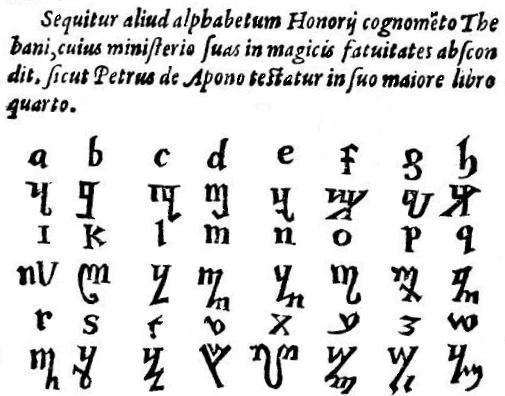
The oldest known book containing the Theban Alphabet is Johannes Trithemius' Polygraphia (1518)

The Latin reads:
“Sequitur aliud alphabetum Honorii cognomento Thebani, cuius ministerio suas in magicis fatuitates abscondit, sicut Petrus de Apono testatur in suo maiore libro quarto" (Here follows another alphabet of Honorius surnamed the Theban, and the use thereof is for hiding the foolishness of his magic, as Petrus de Abano testifies in his greater fourth book.)

The 1561 edition shows the following forms for the letters:

Trithemius' student Agrippa would later include the Theban Alphabet in his Three Books Of Occult Philosophy (book 3 published 1533) (Read it online HERE)

Agrippa has the following to say of the origins of the Alphabet of Thebes:
"Ex horum itaque characterum genere sunt, quos notat Petrus Apponus ab Honorio Theba no traditos, quorum figura est talis ad nostrum alphabetum relata:"
“Of this kind of character therefore are those which Peter Apponus notes, as delivered by Honorius of Thebes, the figures whereof are such, being related to our Alphabet.”

Trithemius and Agrippa claim to have read about this alphabet in an older book of magic attributed to Peter Abano. In this book Peter Abano gives the alphabet and tells how its creator, Honorius the Theban, used the alphabet "for hiding the foolishness of his magic".

I wish I had Trithemius' library. It seems the book he and Agrippa cite has not survived down to the present day. So for now the source of the Theban Alphabet is Trithemius' Polygraphia.

The Theban Alphabet appeared in Francis Barrett's The Magus

It is this form of the Theban Alphabet that was used by the Golden Dawn and from there passed down into Wicca by Gerald Gardner.

The last character of this alphabet contains the Alpha and Omega and is used as a period or full stop.

Source: http://histbest.ub.uni-leipzig.de/receive/UBLHistBestCBU_cbu_00000088